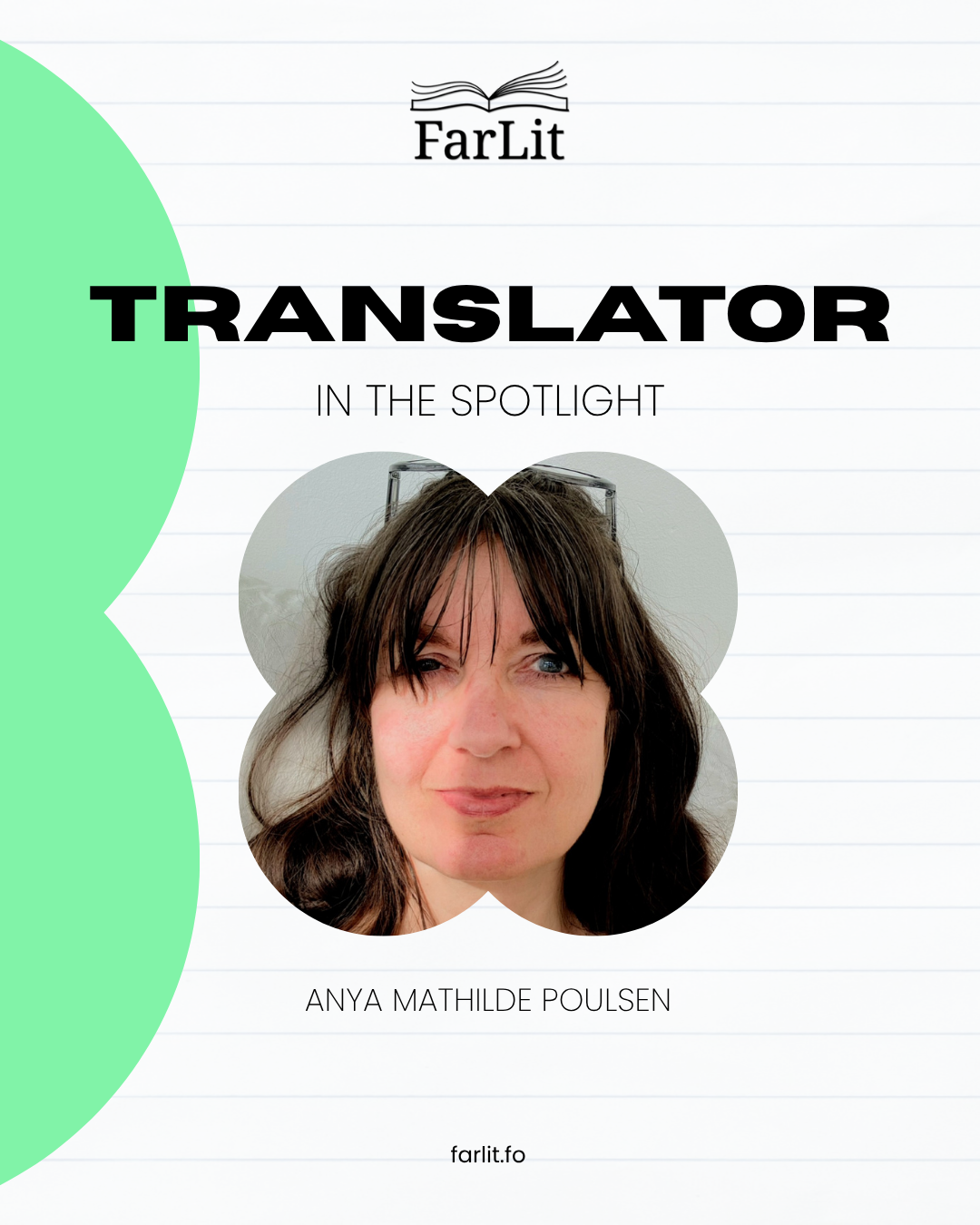
Translator in the spotlight: Anya Mathilde Poulsen
The translator in the spotlight in July is Anya Mathilde Poulsen from Denmark. We asked Anya to answer a few questions about herself:
Who are you?
I’m a librarian, writer, and translator. I am also entirely Danish, which sometimes surprises people, as it is quite uncommon for Danes to have knowledge of Faroese. I have always been deeply interested in languages and fell in love with Faroese many years ago when my father-in-law, who was partly Faroese, invited all of his children and their partners on a trip to the Faroe Islands. I found the language intriguing and beautiful and wanted to unlock its secrets.
In addition to translating Faroese literature, I have also recently co-authored a biography of Bergithe Johannessen, who was the first Faroese painter to complete a formal academic art education. The role and significance of women in art are matters very close to my heart. The biography was published by Sprotin last year with parallel texts in Faroese and Danish. I wrote the text in Danish, however. Translating from Danish into Faroese is something I must humbly leave to others.
What have you translated?
I have translated books by Jógvan Isaksen and Katrin Ottarsdóttir.
When I decided to learn Faroese, it was very difficult to find a course in Denmark. All Faroese people learn Danish and speak it fluently, yet Danish people are rarely expected to learn Faroese. I find that unfair and unbalanced. We are part of the same Danish Realm, after all, and I wholeheartedly think that some knowledge of each other’s languages should be shared. The only course I could find in Denmark back then was taught by Jógvan Isaksen at the University of Copenhagen. I wasn’t a university student any longer, but he let me audit the course, and later he was courageous enough to let me try my hand at translating one of his novels. We are still working together, and it’s been several books now.
A couple of years ago I also began translating for Katrin Ottarsdóttir, so now I have the privilege of working with action-packed crime puzzles as well as poetic language and dark psychology. It’s a great joy to work with authors who are so proficient in Danish and to be able to explore nuances and find the best phrasings together. Katrin and I drink a lot of coffee and spend hours talking about language.
Why do you love Faroese literature?
I am very interested in our Nordic culture and the stories, traditions, and heritage that shape it. Faroese literature and the Faroese language seem to me to carry a strong sense of those roots—much more so than Danish.
What first drew me to the Faroese language was the ballad tradition, the kvæði, and I love the fact that Jógvan Isaksen’s novels often include verses from ballads as well as Faroese poetry and legends. Crime fiction that introduces readers to the rich heritage of Faroese literature - a wonderful combination!
My translator colleagues in this series have already highlighted the quality and vitality of contemporary Faroese literature, and I can only agree. It is puzzling to me why so little finds its way into Danish translation. I really wish that more Danish publishers would recognize the richness of Faroese literature, for the benefit of Danish readers.
Provide a short translated excerpt of your choosing.
This is from my forthcoming translation of Katrin Ottarsdóttir’s short-story collection 7 søgur, which will be published by Jensen & Dalgaard this autumn. The story Lærerinden is set in a Faroese village in the past and is about the deadly jealousy she arouses in one of her pupils.
“Endnu en gang er døren låst. Hun kan heller ikke se ind ad vinduet, for de tykke gardiner er trukket helt for. Hun tør ikke banke på, kan ikke. Hos almindelige folk i bygden er der aldrig låst. Men lærerinden er ikke almindelig. Hun er vist næsten lige så fin som præsten, selv om hun kun er en dame. Hvis nogen så hende stå og banke på døren hos lærerinden, ville de måske sladre til faren, selv om det er nytårsaften, og folk går fra hus til hus og besøger hinanden – mændene gør, i hvert fald. Men hun er ikke en mand, og så er reglerne anderledes, det ved hun.
Hun går bagom huset, ved ikke, hvad hun skal gøre. Igen har hun mest af alt lyst til at knuse ruderne. Dem allesammen. Der er masser af sten på jorden herude. Hun er sikker på, at hun hører orgelspil inde fra huset. Kan det være hende? Den krølhårede? Den fremmede pige? Hun synes, hun kan høre det på spillet, det er så opblæst, så påtaget, som hos en, der vil indsmigre sig hos en anden.
Hun ser dem for sig, ser hvordan lærerinden står der på det fine tæppe, som hun ved, er fra Persien – en gave, hun fik, dengang hun gik på lærerindeskolen i Danmark. Lærerinden kan også godt lide at stå bag hende, når hendes klodsede fingre famler sig tøvende hen over tangenterne. Når både hun og fingrene farer vild i noderne. Men så står lærerinden nok ikke med et lige så drømmende, saligt smil, som hun gør nu. Hun ser også, hvor stor lyst lærerinden har til at kysse den fremmede pige, ser hvordan hun griber fat i krøllerne, løfter dem op fra halsen, så hun bedre kan komme til på præcis det sted, dér i nakken, hvor pigehalse er så fine og bløde og dufter så dejligt – af pige.”